
Industrial composting plays an important role in managing organic waste from food processing, agriculture, municipalities, and commercial facilities. With the increasing demand for efficient waste treatment, businesses often rely on a commercial compost machine to convert organic waste into valuable compost. Among the many equipment designs available, vertical and horizontal systems are two widely used configurations. Each structure has its own advantages depending on the facility layout, processing capacity, and operational goals. Understanding these differences helps operators choose equipment that fits their composting process.
Understanding Industrial Composting Machines
A modern industrial composting machine is designed to accelerate the biological decomposition of organic materials such as food waste, livestock manure, and plant residues. Compared with traditional composting piles, these machines provide controlled temperature, moisture, and aeration conditions, allowing microbes to break down materials more quickly and consistently. Industrial composting facilities can often process organic waste in several weeks under optimized conditions.
Commercial facilities such as farms, waste management centers, and food processors often choose in-vessel composting machines to maintain stable conditions and reduce odor, emissions, and land use.
Vertical Industrial Composting Machines
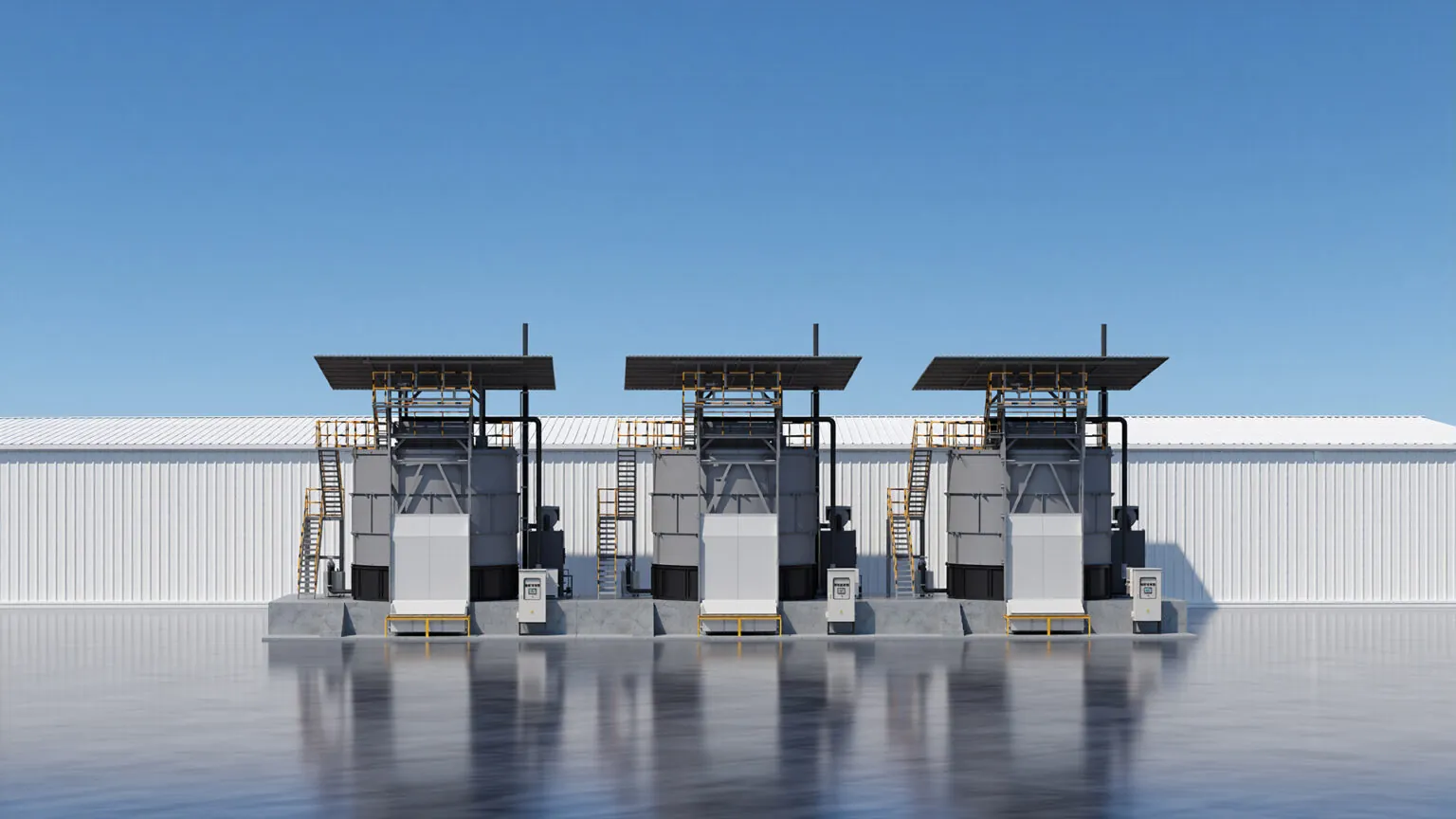
Vertical systems process organic waste within upright cylindrical or tower-like structures. Waste is typically loaded from the top, while finished compost is discharged from the bottom after fermentation and stabilization.
One of the main advantages of a vertical commercial compost machine is space efficiency. Because the composting chamber is arranged vertically, the footprint of the equipment is relatively small compared with horizontal systems. This design is particularly useful for facilities with limited installation space.
Vertical systems also support continuous composting. Organic waste gradually moves downward through different temperature zones, allowing microbes to decompose the material step by step. Controlled aeration and natural convection within the chamber help maintain oxygen supply and stable fermentation temperatures.
In addition, vertical equipment often features automated feeding and discharge systems, which can reduce labor requirements and simplify daily operation. For businesses seeking compact solutions with automated processes, vertical composting machines can be a practical option.
Horizontal Industrial Composting Machines
Horizontal composting machines usually feature a long cylindrical tank or fermentation chamber installed parallel to the ground. Inside the chamber, mechanical mixing systems or turning shafts continuously rotate the materials to maintain aeration and uniform decomposition.
A horizontal industrial composting machine typically offers larger processing capacity than vertical systems. Because the fermentation chamber extends horizontally, operators can load greater volumes of organic waste in a single cycle.
Another advantage of horizontal designs is mixing efficiency. Mechanical agitators ensure that moisture, oxygen, and microorganisms are evenly distributed throughout the compost mass. This can support stable fermentation conditions and help avoid localized overheating or anaerobic zones.
Horizontal machines are commonly used in large composting facilities where space is less restricted and high throughput is required. They are well suited for handling agricultural residues, livestock manure, and large volumes of municipal organic waste.
Choosing Between Vertical and Horizontal Systems
Selecting the right composting equipment depends on several operational factors.
Facilities with limited space or moderate waste volumes often benefit from vertical composting machines because of their compact footprint and continuous operation design. Operations that process high volumes of organic material may prefer horizontal systems due to their larger capacity and strong mixing capabilities. Other considerations include automation level, maintenance requirements, energy consumption, and the type of organic waste being processed.
A Practical Solution for Commercial Composting
For businesses seeking a compact yet efficient commercial compost machine, the Cason C-120E offers a practical vertical composting solution. Designed for controlled in-vessel composting, this equipment supports stable aeration and temperature management while occupying limited installation space. The Cason C-120E helps facilities convert food waste, agricultural residues, and organic by-products into usable compost within a managed system. With its vertical structure and automated operation, it provides a suitable option for restaurants, farms, waste management centers, and commercial composting facilities