
Buying a fertilizer fermentation tank usually starts with a capacity question. It should start with the manure stream. This fertilizer fermentation tank buying guide explains how to choose a fertilizer fermentation tank using daily output, moisture, heat, airflow, site limits, and after-sales support.
A cheap-looking tank can become a bottleneck when the flock grows, while an oversized vessel ties up money and power.
What Should You Calculate before Choosing a Fertilizer Fermentation Tank?
Write down the farm figures before comparing models. For practical livestock manure management, measured collection data will always beat a rough estimate. It also gives each supplier the same brief, making quotations easier to compare.
Estimate Daily Manure Output
For laying hens, plan on 0.12 to 0.15 kg of manure per bird each day. A 100,000-bird layer farm produces about 12 to 15 tonnes daily. Broilers often produce 0.09 to 0.12 kg per bird, while finishing pigs produce roughly 2 to 4 kg per head. Use measured data when available, then allow for wet bedding and expansion.
Match Volume to the Working Cycle
Ask for rated input volume, not only nameplate volume. Finished fertilizer weighs less than wet feed because water leaves during fermentation. If the farm cannot process one day’s manure within the cycle, overflow storage returns as a compliance and odor problem. A three to five year growth margin beats buying the smallest tank that fits today.
Which Fermentation Process Fits Your Manure?
A manure treatment system should suit the material entering it. Poultry manure composting can move quickly because the material is often drier and richer in nitrogen, but it still needs the right moisture, airflow, and carbon balance.
Control Moisture and the C:N Ratio
High-temperature aerobic fermentation works best around 55% to 65% working moisture and a carbon-to-nitrogen ratio near 25 to 30:1. Rice hulls, straw, or wood shavings can bring wet manure into range and add carbon.
Too much water blocks oxygen. Too little slows microbial activity. Ask whether the supplier will help set a recipe for your actual manure instead of handing over a generic number.
Check the Heat and Hygiene Target
A sealed aerobic cycle wraps up in barely a week. In contrast, open windrows take 30 to 60 days. Just maintain 55°C to 65°C for 72 straight hours. This effectively destroys Salmonella, E. coli, Ascaris eggs, and weed seeds.
A poultry manure management whitepaper shows a well-handled setup strongly supports organic fertilizer production. Therefore, it hits NY/T 525-2021 targets. Those standards demand 45% organic matter and 5% total NPK. Plus, moisture must remain under 30%.
What Tank Materials and Controls Matter Most?
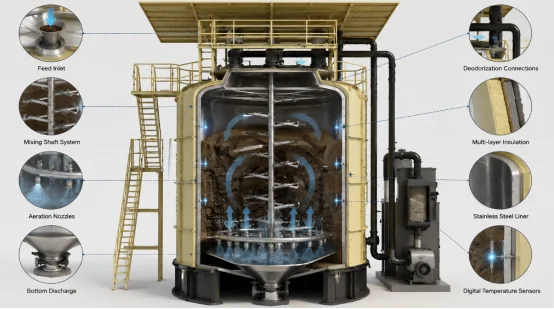
Manure is abrasive, wet, and chemically aggressive. The liner and air system decide whether in-vessel composting equipment keeps working after several winters and thousands of loading cycles.
Inspect the Liner and Insulation
Ask for the liner grade in writing. A 304 stainless-steel inner liner is a sensible minimum for corrosive manure service. Mild steel can pit quickly in high-ammonia conditions. High-density polyurethane insulation helps the vessel retain self-generated heat in cold weather. Request ambient-temperature test data if the farm operates below freezing.
Look at Aeration and Odor Control Together
Continuous airflow prevents anaerobic pockets and sharp odor. A centralized deodorization unit should collect displaced air before release. Ask for odor-removal data, fan power, noise, and the cleaning routine. The referenced whitepaper reports 90% to 98% deodorization for an integrated system, but request the test method and comparable site records. Numbers without context are just brochure numbers.
How Should You Compare Energy, Space, and Labor?
The purchase price is one line in the project budget. Electricity, civil work, labor, and downtime decide the rest.
Measure the Site before the Quote
Vertical in-vessel equipment can use about 60 to 120 square meters, far less than an open compost pad. Leave space for the hopper, service access, finished-product handling, and trucks. Check foundation loads and power supply early. Weak airflow stretches the cycle and leaves cold zones.
Ask How Many People Must Run It
PLC controls can automate aeration, temperature records, and cycle alarms, allowing one trained operator to handle routine work. Ask what remains manual, how alarms arrive, and whether remote diagnosis is available.
Annual maintenance often runs 5% to 8% of the initial equipment cost. Filters, bearings, blower service, and common spare parts should therefore appear in the quotation.
What Should You Check in a Supplier’s Proposal?
A capable fermentation tank supplier should show how the equipment will work on your farm, not just how it looks in a brochure. The proposal should also leave a clear paper trail for regulators and your maintenance team.
Request a Complete Technical Package
Ask for a process flow, input limits, effective volume, installed power, liner material, insulation thickness, deodorization method, control screens, and utility requirements. Include installation, commissioning, operator training, spare parts, and delivery terms. Request references from farms with similar manure volume and climate.
Confirm Testing and Service Terms
Before signing, agree on temperature logging, moisture checks, acceptance criteria, warranty coverage, and response time for failures. Ask who pays for travel and replacement parts during the warranty period. A low quote without service language is not a low-risk quote. It is an unanswered question.
A Practical Fit for Your Farm’s Next Step
The right supplier should discuss manure type, daily volume, moisture, land, and power before recommending a model. Cason’s range covers poultry, pig, cattle, sheep, rabbit, and duck operations. Its DT-320E page describes energy-saving fans, centralized deodorization and electrical control, remote conveying, sealed processing, and support from planning through after-sales service.
The company also presents customizable configurations and maintenance tools. These details do not replace a site calculation, but they give you useful questions for a technical meeting. Review the DT-320E product information and the wider Cason equipment range before requesting a farm-specific proposal.
FAQ
Q1: How do you choose the best tank size for poultry manure?
A: Start with measured daily manure output, then add a three to five year growth margin and confirm the rated wet-input capacity.
Q2: What moisture level does aerobic fermentation need?
A: Most high-temperature aerobic systems target about 55% to 65% working moisture. Bulking agents can correct manure that is too wet.
Q3: How long does a fertilizer fermentation tank cycle take?
A: A controlled high-temperature aerobic cycle can take about seven days. The material should stay at 55°C to 65°C for at least 72 hours for pathogen control.
Q4: Which tank material lasts longer in manure service?
A: A 304 stainless-steel liner is a practical baseline because manure acids and ammonia can damage mild steel.
Q5: What should be included in a fertilizer fermentation tank cost comparison?
A: Include the tank, fans, deodorization, controls, civil work, installation, training, electricity, consumables, spare parts, and annual maintenance.