
TL;DR: Choose CF-1000 for batches up to 1 tonne and CF-2000 for batches up to 2 tonnes, then verify site power, floor area, moisture and batch frequency before ordering.
The model decision starts with one practical question: how much material must enter each batch on the busiest realistic day? CF-2000 handles a larger batch, but extra capacity only helps when the facility can feed it consistently and support the higher electrical load. CF-1000 can be the cleaner fit for a smaller or less predictable mortality stream.
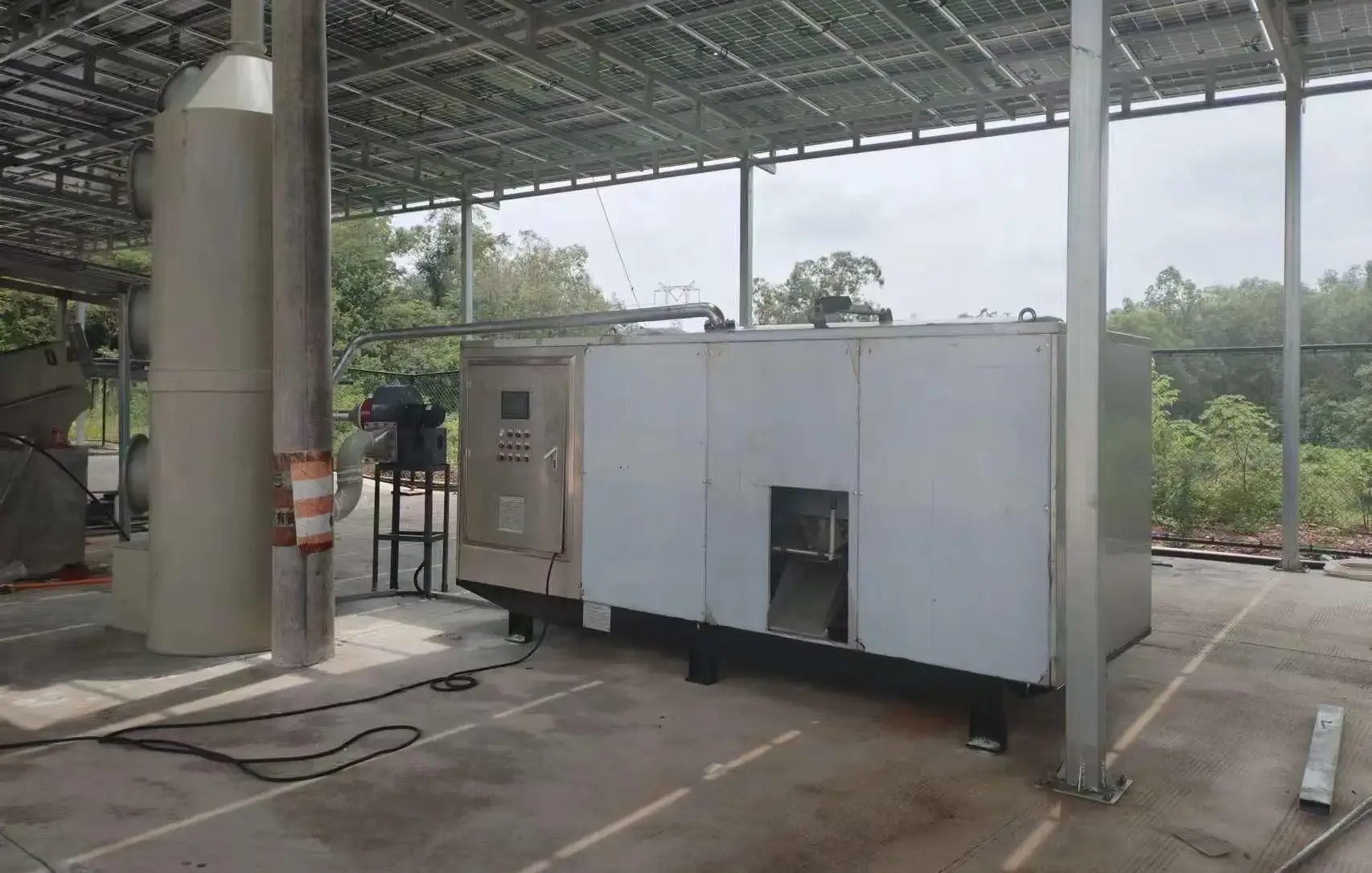
How much carcass volume must each batch absorb?
Start with records, not farm population alone. Pull at least several months of mortality data and separate ordinary losses from short peaks. Record carcass type, individual size range, daily mass, storage time before treatment and any auxiliary material added to the batch.
The published batch ratings include auxiliary material. CF-1000 is rated for 1 tonne per batch, while CF-2000 is rated for 2 tonnes.
A site that generates 1.2 tonnes over several days may still fit CF-1000 if its approved holding and treatment plan allows two smaller batches. A site that regularly receives close to 2 tonnes at once may need CF-2000 to avoid an operational queue.
Daily mortality does not automatically equal required batch capacity. Batch timing, temporary holding controls, labor coverage and the locally approved treatment route change the answer. During suspected disease events, follow instructions from the responsible veterinary authority before moving or processing carcasses.
What do the CF-1000 and CF-2000 specifications show?
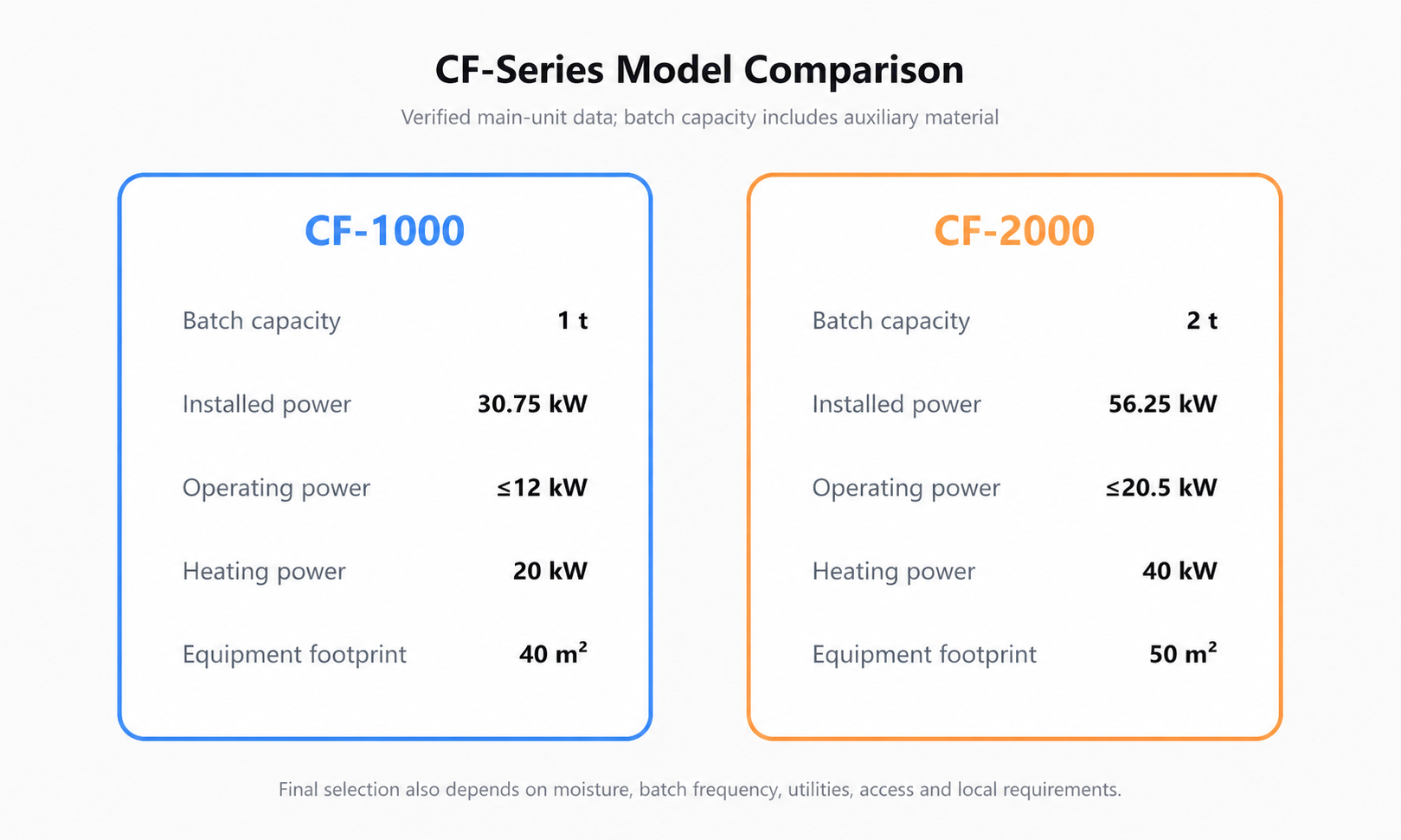
The table below uses Cason’s model data for the main unit. It provides a shortlist, not a final electrical or civil design.
| Selection item | CF-1000 | CF-2000 | What the buyer should check |
| Approximate main-unit weight | 5.0 t | 7.8 t | Foundation and lifting plan |
| Batch capacity, including auxiliary material | 1 t | 2 t | Peak batch mass, not just annual average |
| Installed power | 30.75 kW | 56.25kW | Connected-load allowance |
| Operating power | Up to 12 kW | Up to 20.5 kW | Normal operating demand |
| Electric heating power | 20 kW | 40 kW | Heating circuit and site supply |
| Equipment footprint | 40 m2 | 50 m2 | Usable area plus access clearances |
| Electricity per batch with auxiliary material | 260-280 kWh | 320-340 kWh | Season, moisture and discharge requirement |
The electricity ranges need context. They may rise or fall with ambient season, incoming moisture and the required discharge condition. A quotation should therefore state feedstock assumptions and the intended operating cycle instead of presenting one electricity figure as a universal result.
How should you check the site’s electrical capacity?
Installed power, operating power and heating power answer different questions. Installed power helps the electrical engineer size the connection and protective equipment. Operating power describes expected running demand under stated conditions. Heating power identifies the dedicated heating load within the system.
For CF-1000, the listed installed power is 30.75 kW, operating power is up to 12 kW and electric heating power is 20 kW. CF-2000 lists 55.5 kW installed power, up to 20.5 kW operating power and 40 kW electric heating power.
Ask the site electrical engineer to review available transformer capacity, voltage and frequency, cable routes, protective devices, starting behavior and other loads that may run at the same time. Do not size the supply from average operating power alone.
The CF-1000 product page and CF-2000 product page also outline the mixing, heating, control, discharge, ventilation and deodorization systems that must be coordinated in the project design.
How much floor area should the layout reserve?
The listed equipment footprints are 40 m2 for CF-1000 and 50 m2 for CF-2000. Those figures should not become the building footprint without an approved layout. A workable installation also needs feeding access, discharge handling, safe walkways, maintenance clearance, ventilation and deodorization connections, drainage interfaces and lifting access.
Draw the full material path. Show where carcasses arrive, how they enter the unit, where auxiliary material is stored and how treated material leaves. Keep operator movement from crossing the dirty and clean sides of the process.
Review comparable carcass-treatment projects for layout context, then request model-specific drawings before civil work starts.
Approximate main-unit weight also matters. CF-1000 is listed at about 5.0 tonnes and CF-2000 at about 7.8 tonnes. The project engineer must use approved load data, foundation drawings and local structural requirements rather than these approximate values alone.
How can mortality records become a model shortlist?
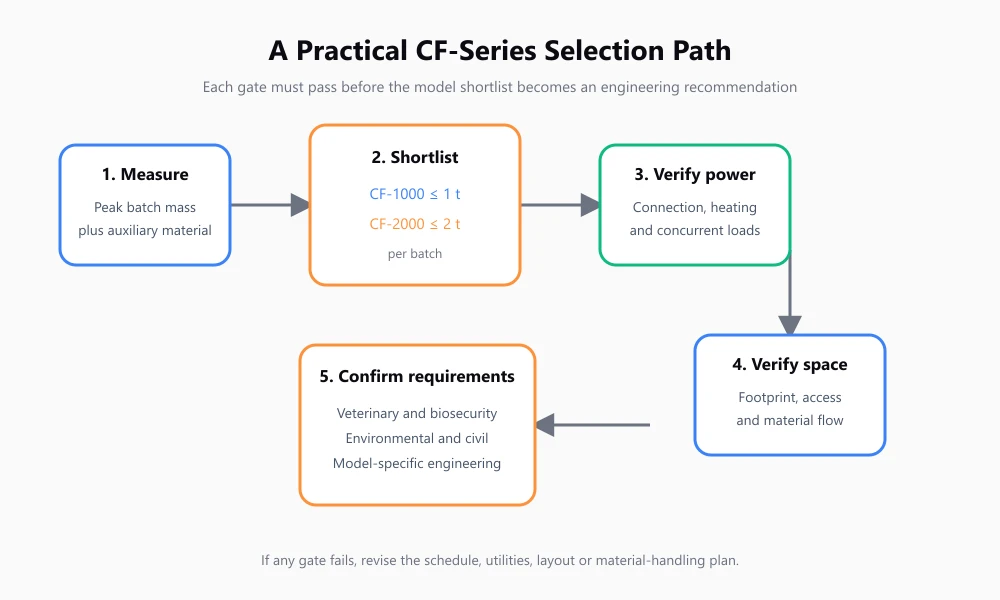
Use a simple worksheet for the busiest credible operating period. Enter the carcass mass available at each planned batch, add the expected auxiliary material, and compare the total with rated batch capacity. Then calculate how many batches the team can complete within its approved operating schedule.
Next, test the shortlist against three site limits. Confirm enough connected power, confirm usable process space and confirm the feeding and discharge plan can handle the selected batch. If one limit fails, a larger vessel does not solve the project. The facility may need a revised schedule, utility upgrade, layout change or a different material-handling arrangement.
Do not use livestock headcount as a shortcut for batch demand. Two farms with the same population can have different mortality patterns, carcass sizes, holding arrangements and risk controls. Actual mass records provide a better engineering input.
Before requesting a quotation, document the assumptions behind the worksheet. State whether the batch mass includes bedding, absorbent or other auxiliary material. Record the moisture condition at loading and the discharge condition the operation expects. Note the planned operating hours, staff availability and any refrigeration or temporary holding limit set by the approved mortality plan.
These details make quotations comparable. One supplier may base electricity on a wetter feedstock or a different discharge target, while another may assume a lighter auxiliary-material ratio. Ask for the model, units, feed assumptions and operating boundary beside every figure. If a value is unavailable, leave it open for engineering confirmation rather than filling the gap with an estimate.
The same discipline applies to capacity. Treat 1 tonne and 2 tonnes as batch limits under the stated configuration, not promises of daily output under every site condition. Daily throughput depends on the full loading, treatment, discharge and cleaning schedule.
Which model fits each operating pattern?
CF-1000 is the stronger shortlist when the batch, including auxiliary material, stays within 1 tonne; the site benefits from the lower installed and operating loads; and 40 m2 of equipment footprint fits the process area. It also suits operations that prefer smaller, more frequent batches, provided the approved operating schedule supports them.
CF-2000 belongs on the shortlist when the batch can approach 2 tonnes, the site can provide the higher electrical capacity and 50 m2 equipment footprint, and the feeding and discharge system is designed for the larger batch. The extra capacity should solve a measured bottleneck, not serve as unused margin.
A final choice needs engineering confirmation. Send expected carcass types, peak batch mass, auxiliary-material estimate, incoming moisture, available floor area, electrical supply and desired schedule through our project consultation page. We can then review the data against the selected CF model and prepare model-specific requirements.
FAQ
Is CF-2000 always cheaper per tonne?
No universal cost-per-tonne figure is supported. Per-batch electricity depends on season, moisture and discharge requirements, while utilization depends on how consistently the facility can fill the larger batch. Compare a site-specific schedule and utility cost rather than dividing one catalogue value by capacity.
How much spare capacity should a facility buy?
Use recorded peak batches and an agreed contingency, then check whether the extra volume will be used. Oversizing can add connected load, heating capacity and space without improving the treatment schedule.
Can the rated footprint be used for the building design?
No. The rating describes equipment footprint. The building and process layout must also accommodate access, feeding, discharge, maintenance, ventilation, odor treatment, drainage and safety clearances.
Does choosing a CF model confirm legal approval?
No. Disposal and treatment requirements vary by jurisdiction and disease context. Confirm the method, site, movement controls and operating plan with local veterinary, biosecurity and environmental authorities before procurement or use.