
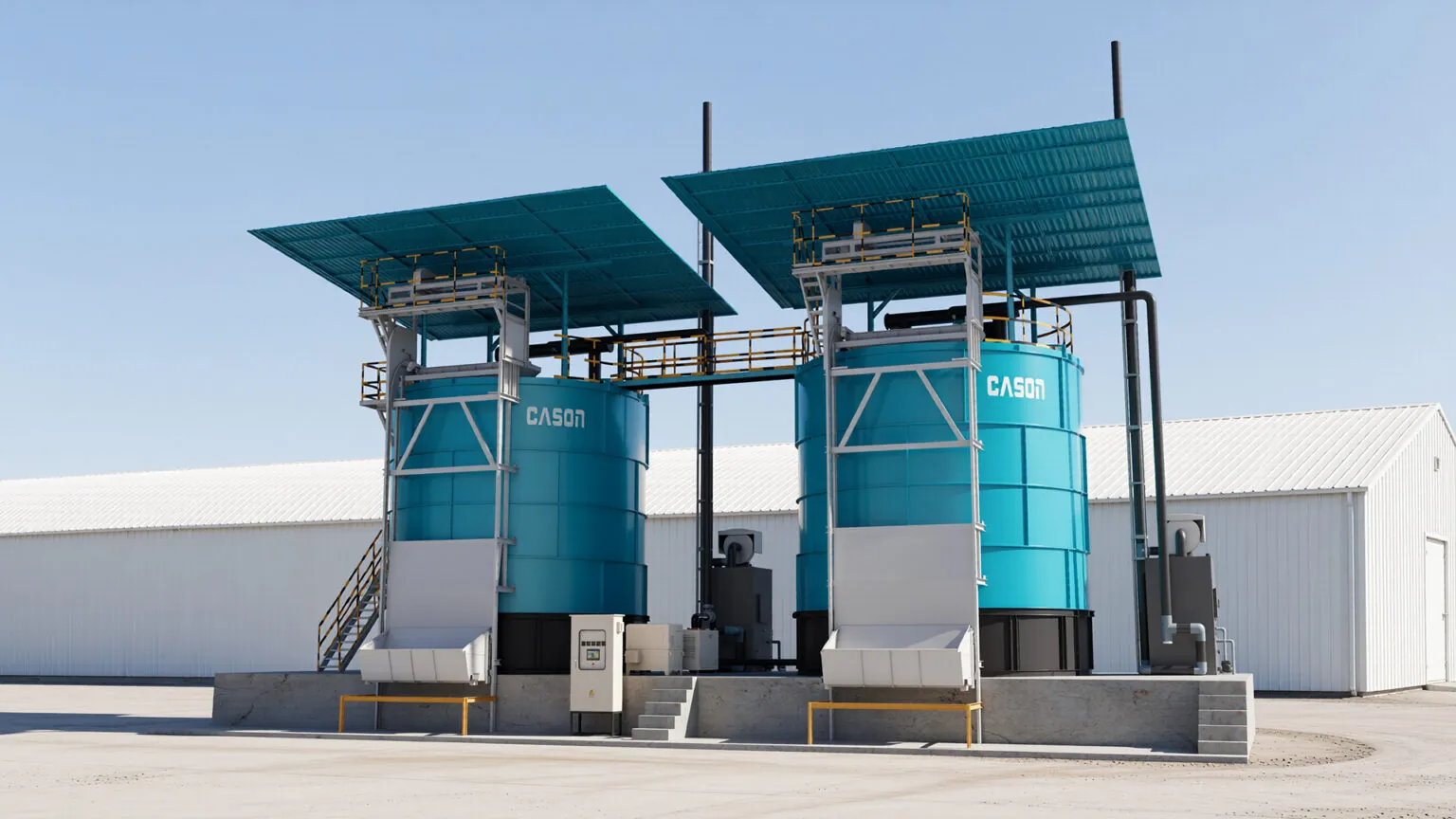
At Cason, we understand the challenges farms face when managing organic waste efficiently while maintaining productive land for crops and livestock. In-vessel composting offers a controlled environment for organic matter to decompose rapidly, but space constraints can limit its adoption. Our in-vessel composter with a dual-tower design addresses this issue by making better use of vertical space, allowing farms to process large volumes of organic waste without occupying extensive ground area.
How Vertical Space Enhances Composting Efficiency
Traditional composting systems, such as windrows or single-tower vessels, often require significant land to accommodate large waste volumes. By adopting a dual-tower design, an in-vessel composter stacks composting chambers vertically, effectively doubling processing capacity within the same footprint. This approach is particularly beneficial for operations with limited land but high organic waste output. Farms can maintain composting throughput without compromising space available for crops, pastures, or other farm activities.
Design Advantages of a Dual-Tower In-Vessel Composter
The dual-tower configuration provides more than just spatial efficiency. Each tower in the Cason in-vessel composter is independently aerated and monitored, allowing for simultaneous processing of different waste streams or staggered composting cycles. This separation helps optimize temperature and oxygen distribution throughout each tower, supporting uniform decomposition and high-quality compost production.
Mechanical agitation and automated aeration systems are integrated within the towers to maintain ideal conditions for microbial activity. With precise control over temperature, moisture, and airflow, the dual-tower design ensures stable composting even when handling high volumes of organic material. These features reduce operational risks while improving process consistency, allowing farms to achieve predictable compost output without expanding their operational footprint.
Benefits for Land Use and Farm Productivity
Maximizing vertical space with a dual-tower in-vessel composter helps farms optimize land use. Instead of dedicating large plots for composting operations, farms can allocate more space to crops, grazing, or other productive activities. The compact footprint of the Cason DT-320E enables high-volume composting on smaller parcels of land, supporting sustainable organic waste management while maintaining operational efficiency.
The dual-tower design also allows farms to scale composting capacity incrementally. Adding a second tower increases throughput without requiring additional land or major infrastructure changes. This flexibility makes it easier for farms to adapt to changing waste volumes and operational needs.
Sustainable and Efficient Organic Waste Management
At Cason, we prioritize solutions that enhance both operational efficiency and environmental sustainability. Our dual-tower in-vessel composter provides a space-conscious approach to organic waste management, converting manure, crop residues, and other organic matter into nutrient-rich compost while minimizing land use. Farms benefit from a controlled, high-volume composting system that supports productive land use, reduces odor and pathogen risks, and delivers consistent, high-quality fertilizer for soil health.
The Cason DT-320E dual-tower in-vessel composter demonstrates how thoughtful design can maximize vertical space and make high-volume composting achievable for farms of all sizes.