
Managing organic waste efficiently begins with a clear understanding of how a well-designed animal waste fermentation equipment system operates. In our daily work at Cason, we see many farms seeking faster and more reliable fertilizer production, yet they often overlook the foundational principles of controlled aeration, temperature stability, and consistent feeding. When these elements align, the manure fertilizer fermentation tank can maintain a favorable microbial environment, allowing the biological process to progress smoothly. By monitoring oxygen levels and internal heat distribution, we ensure that the fermentation path remains stable and avoids unnecessary delays. This understanding lays the groundwork for more advanced operational strategies.
Practical Steps for Improving Fermentation Efficiency
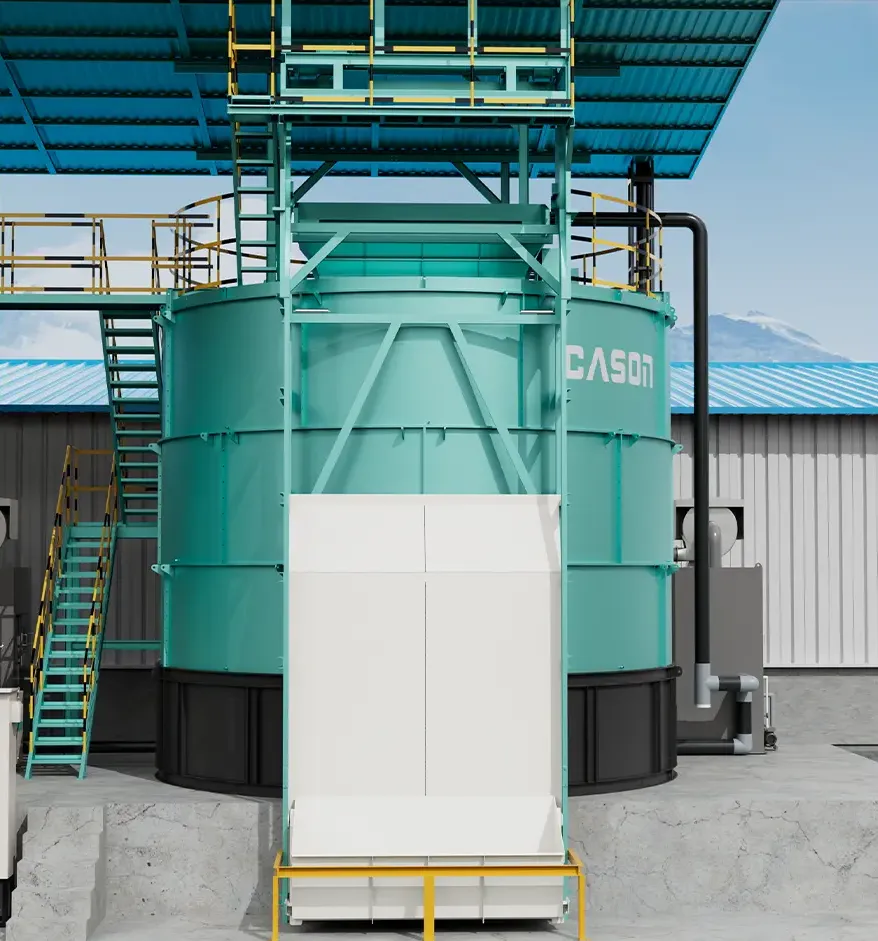
Enhancing the speed and quality of fertilizer output depends on both process control and reliable equipment coordination. We always encourage clients to focus on material consistency, airflow design, and moisture balance within the animal waste fermentation equipment system. Our company’s engineering team has improved the airflow channels and insulation structure inside each manure fertilizer fermentation tank, helping farms maintain stable temperatures even during peak-load operation. Smooth material loading is another essential factor. This is where our DT-240E Hopper Lifting System becomes valuable. As an integral part of the conveying line, the hopper lifting structure moves material from ground level to the tank inlet with accuracy, allowing continuous, even feeding. By cooperating with our intelligent conveying system, it prevents sudden material surges and protects the core fermentation cycle from disruption.
Integrating Service, R&D, and Production Capacity for Better Outcomes
Consistent fertilizer quality is not only a result of proper operation but also of dependable system support. Over the years, we have strengthened our R&D efforts to ensure our animal waste fermentation equipment adapts to evolving industry requirements. Our workshop’s strong production capacity enables us to provide timely delivery without compromising structural precision or durability. Feedback from many projects has shown that stable construction and thoughtful design significantly improve internal fermentation efficiency. Moreover, our team maintains frequent communication with clients, offering operational guidance that helps them adjust their manure fertilizer fermentation tank settings as farm conditions change. This cooperation encourages smoother long-term operation, especially for large farming groups and association-managed facilities.
Conclusion:Building a Reliable Path Toward Faster and Higher-Quality Fertilizer Output
Achieving fast and consistent fertilizer production requires more than simply owning high-capacity equipment. It depends on understanding fermentation principles, operating tanks with precision, and integrating systems like the DT-240E Hopper Lifting System for controlled material feeding. Through our experience, we have seen how well-planned processes, equipment coordination, and comprehensive service collectively enhance the performance of the animal waste fermentation equipment and the manure fertilizer fermentation tank. By continuing to refine our technology and support, we aim to help more farms establish dependable, efficient, and sustainable fertilizer production systems.