
“We have ten tonnes of manure a day” is usually the first number we hear. Before putting it beside a composter rating, we need to find out what the ten tonnes contains. Is it freshly scraped manure? Does it include bedding? Was the material weighed before a separator, or after dry material was added? A different answer changes the load at the equipment inlet.
At Cason, the number we put beside a machine rating is the prepared feed at its inlet. The collection diary may say ten tonnes, yet the hopper could see a smaller cake stream or a larger mix once bedding is added. We put the busiest collection day beside the proposed feeding hours. That is where a comfortable-looking average sometimes stops being useful.
Find the measurement point
We draw the route on one sheet, starting at the barn outlet and ending at the composter hopper. A press, mixer or bedding store belongs on that drawing if it changes what the hopper receives. Beside each arrow, we write the quantity and how it was obtained. An empty space is useful; it tells us where a trial is still needed. We have seen capacity discussions go astray when a raw-slurry figure is compared with a rating for prepared cake. The reverse happens too: cake is counted, but the dry material tipped into the mixer is overlooked.
Our discussion of manure moisture before composting covers one part of this preparation decision. Capacity needs its own inlet measurement. A moisture percentage will not tell us how many cubic metres the feeder must move during a shift.
Collection method gives the numbers their meaning. A scraper brings a different mix to the yard from a flush channel, and a bucket may include bedding from only one house. If those streams will meet in the mixer, we can total them there. Before that point, separate entries are more honest. Where no weighbridge exists, operators often know the bucket count. We use it as an observation, then verify bucket size and fill before treating the count as a volume measurement.
Record an operating week, including the difficult day
We ask for a dated daily log. For each load, note its collection point, time, mass or measured volume, and any visible change in material. Include ordinary cleaning days and the day on which the largest batch reaches the proposed treatment area. If collection varies with season, bedding practice or washdown, one week is a starting record rather than a description of the whole year.
Consider what the time column can reveal. The same daily mass may arrive as small loads across a shift or as one large delivery after morning cleaning. In the second case, we check how long the loader will be at the hopper, how fast the feeder accepts material and where the queue of manure waits. None of those questions is answered by a daily vessel rating.
Our log has three marks beside its figures: scale reading, site estimate or planning assumption. The marks are deliberately plain. A beautifully balanced spreadsheet can conceal an unweighed stream; a rough log with honest labels gives us a better starting point for a trial.
| Record | Site observation we need | Capacity question it answers |
| Daily intake | Quantity at a named measurement point, recorded by date | What is the normal treatment duty? |
| Busiest day | Largest observed arrival, including any stored material released | What load must the route recover from? |
| Loading window | Hours when staff and equipment can feed the system | Can the receiving equipment accept the batch? |
| Bedding and additions | Material and quantity added before the composter inlet | How much prepared feed will enter? |
| Storage | Holding time and maximum batch held between collection and feeding | What buffer is available during an interruption? |
A tonne is not a cubic metre
The unit printed beside a capacity number deserves a close look. Tonnes per day measure mass; cubic metres per day measure volume. A manufacturer’s vessel volume describes the vessel itself. It cannot be read as a daily treatment promise. Try filling two equal buckets, one with wet cake and the other with a loose cake-and-bedding blend. They need not weigh the same, although they occupy the same space.
For a mass-to-volume comparison, we take a bulk-density measurement of the proposed inlet mix. We tare a container whose volume is known, fill it without a different compaction method from normal feeding, and weigh the contents. Several batches are better than one neat sample. A note on how the container was filled belongs with the result. Otherwise a winter blend with wetter bedding may inherit a density measured on a dry summer batch.
A volume-to-mass conversion can go wrong at the first bucket. Operators rarely fill a loader identically on every trip; a pile’s rough outline adds still more uncertainty. We retain the observed bucket count or pile estimate beside any converted value. The spreadsheet should not gain decimal places that the site measurement never had.
Our C-series ratings show why the conditions must travel with the number. At a stated inlet moisture of 70%–75%, the listed daily treatment ranges are 6–9 m³ for C-90E, 8–12 m³ for C-120E, 10–14 m³ for C-140E and 12–16 m³ for C-160E. These are conditional ranges. We would check the farm’s actual prepared feed, loading pattern and current model specification before using one to select equipment from our manure composting range.
Recalculate after separation or mixing
The stream at the composter inlet may be quite different from the material collected at the barn. A separator takes liquid away; a mixer may add dry bedding or another bulking material. Both change the mass and the space occupied by the feed. We calculate the treatment load from a trial of the proposed route, not from an assumed percentage of water removed.
For a separation trial, weigh the starting slurry and the cake. Record the liquid collected and any material left in the equipment. Then measure the dry addition, if the cake still needs mixing. For a direct-feed route, measure the same additions without a separator. The trial tells us what the vessel will receive; it also gives the separator and liquid storage their own, different duties.
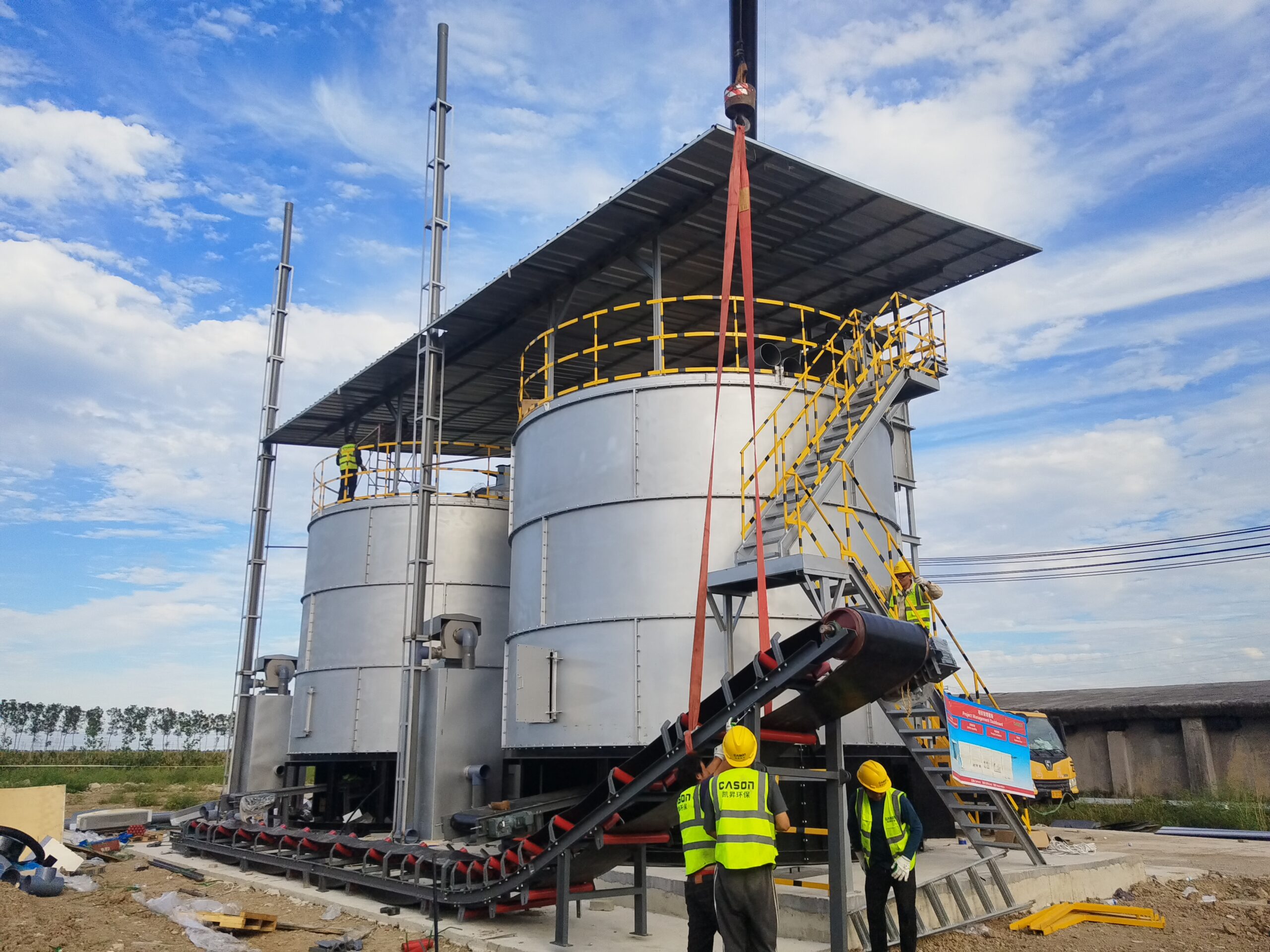
The Dingli project shows separation and premixing ahead of fermentation tanks. We use that arrangement to illustrate why the inlet stream must be identified. It is one project’s solution, not a default equipment list or a throughput guarantee for another farm.
Watch the material while the trial runs. A mix can look dry in a tray but bridge in a hopper, wrap around a screw or compact after a short wait. Those handling observations belong beside the volume and moisture results. If the proposed feed cannot be loaded consistently, a nominal daily rating will not cure the bottleneck.
Check the week, not only the peak day
The calendar can be a hidden bottleneck. Manure may arrive seven days a week even when a team feeds the composter on five. We ask where the weekend material sits and when it will be cleared. The same loader may also be committed to bedding or feed handling during the proposed loading hour. Put that conflict on the schedule before increasing the nominal vessel size.
We make room on the schedule for service and a stopped feeder. Some sites can hold a day of material; others cannot. The answer depends on the storage area, its drainage and the farm’s collection pattern. Once the operator tells us the permitted holding time, we can work out a recovery plan. A larger vessel may be part of it, but a larger hopper or a different feeding shift may matter more.
When buyers compare models, we ask them to put the same prepared-feed description beside every supplier’s stated rating. Does the rating refer to raw wet manure or to a prepared mix? Which moisture condition and operating period apply? Is the figure a tested range or a nominal vessel size? Our fermentation-tank selection guidance addresses the wider site choice; here we are checking the inlet duty that any selection must satisfy.
Send a capacity brief we can actually use
The useful first submission is short: a dated intake log, a sketch marking each measurement point, normal and peak quantities, the busiest loading period, moisture or dry-solids results, bedding and amendment quantities, and the proposed preparation route. Add a bulk-density measurement if the site uses mass and the candidate rating uses volume. Mark missing tests openly.
Send that record through our equipment enquiry page. We can compare the prepared-feed duty with the relevant rating conditions, identify a receiving or storage bottleneck, and tell the buyer which measurement is still needed before we recommend a model.