
How Do Large-Scale Chicken Farms Handle Manure Across Multiple Sites? 35 Fermentation Tanks at Dingli Group
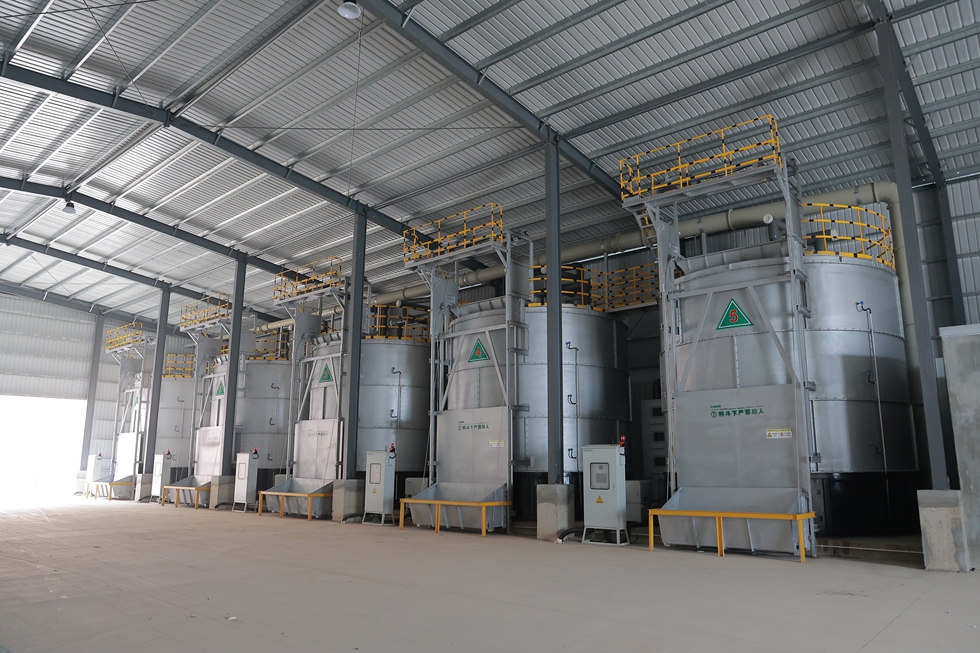
Dingli Group operates 35 CASON C120E organic fertilizer fermentation tanks (120 m³ working volume each) across five large-scale chicken sites: Panshi, Liuge, Gaodi and two Xiaoji farms. Rather than rolling out one standard package, tank numbers and downstream equipment were sized individually for each site based on flock size, manure transport routes and available space. All sites share one route: belt collection in the houses, central collection, enclosed high-temperature aerobic fermentation, then screening and bagging where a finished product is targeted. Based on measured throughput of around 6 tonnes per tank per day on comparable installations, total capacity is roughly 210 tonnes of chicken manure per day.
Why one standard package cannot cover every site
The most common mistake a livestock group makes is choosing equipment before defining the problem. Dingli Group makes the conflict easy to see. Its breeding sites differ in flock size, civil engineering conditions, building layout and available land. Any single standard configuration lands either oversized, leaving idle capacity, or undersized, leaving manure stacked in the yard. The workable approach is to break each site down first, then size the equipment.
Three problems with open stacking
- Cycle time and footprint are uncontrollable. Windrow composting depends heavily on ambient temperature, so curing drags out in cold months — while manure arrives every single day.
- Odor and compliance pressure. Open piles have no containment and no centralized deodorization, so ammonia and hydrogen sulfide escape uncontrolled. This is one of the most frequent triggers for neighbor complaints and regulatory deadlines.
- No revenue path. Material from open piles varies in moisture, particle size and nutrient content, so it rarely meets the consistency required of a commercial organic fertilizer. It is usually given away or applied to land at little or no value.
What multi-site operators face on top of that
A single farm only solves for volume. A group also has to solve for distribution. The cleaning method in the houses decides whether manure is produced centrally or spread out. Transport distance and elevation decide whether one conveying design can serve every site. Whether a finishing line is needed depends on how far the fertilizer has to travel to market. Those three variables together determine whether a site gets five tanks or ten, and whether screening and bagging belong in the scope.
The solution: one process route, configured per site
One backbone, tailored sections
Chicken houses → Belt conveyor → Central manure collection → Enclosed C120E fermentation tanks → High-temperature aerobic fermentation → Discharge → (Optional) screening / impurity removal / automatic bagging → Commercial organic fertilizer
The front end keeps manure out of the houses and the breeding area. The middle section delivers hygienic, compliant treatment. The back end decides whether the site sells raw composted material or a finished bagged product. Almost all of the difference between Dingli’s five sites sits in this last section.
Keeping one backbone brings practical benefits: a single environmental reporting structure, shared spare parts and service standards, and operators who can move between sites — without forcing a configuration onto a site that would then run permanently starved or overloaded.
Why the C120E
The C120E is CASON‘s main model for large-scale livestock operations, with a working volume of 120 m³ and an enclosed high-temperature aerobic fermentation process. What matters most to a producer is not the datasheet but what comparable installations actually achieve: on sites already in operation, the C120E runs at roughly 6 tonnes of feedstock per tank per day.
Key configurations proven in service include:
- Energy-saving blowers that reduce long-term power cost
- Yuken (Japan) hydraulic pump heads for reliability under heavy mixing loads
- Siemens control systems supporting automation and remote monitoring
- Japanese-process high-pressure stainless exhaust blowers rated for humid, sulfide-bearing gas
- Optional: centralized air supply, centralized control, centralized deodorization, mobile control terminals, and standalone supervisory computers for multi-tank groups
How tank counts are derived
Three variables decide the number of tanks: daily manure output, stable feedstock throughput per tank, and the maintenance buffer the operator wants. Daily output follows from flock size and cleaning frequency; throughput per tank follows from vessel volume and feedstock moisture. Matching the two defines the range, then 10–15% is added so tanks can be taken offline for service without stopping the site.
Five sites in operation
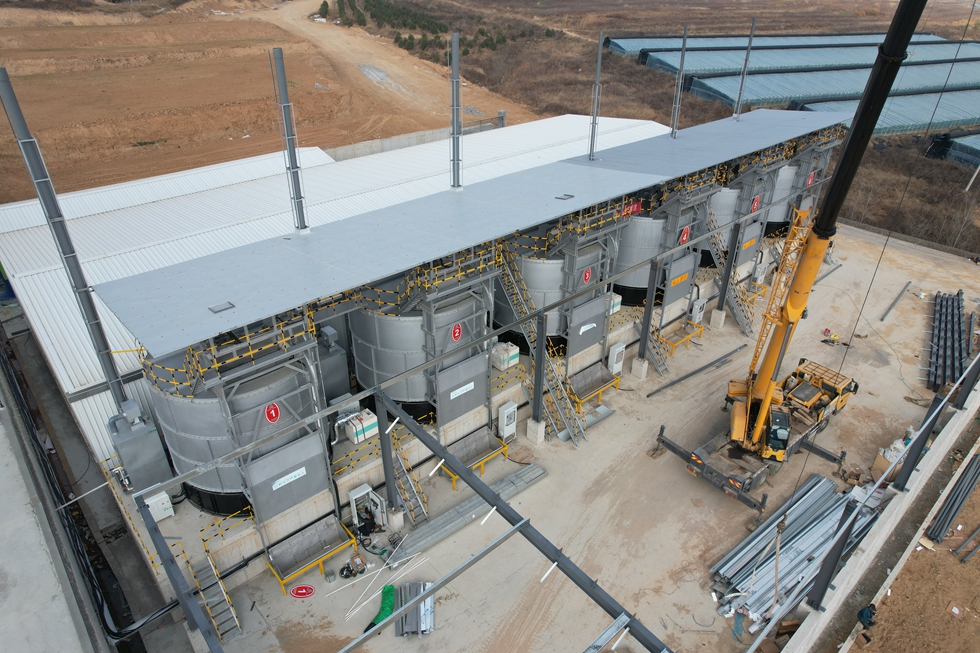
Panshi: integrated breeding, treatment and fertilizer production (6 × C120E)
Panshi was built as an integrated site covering modern breeding, environmental treatment and organic fertilizer production, with six C120E tanks. All three stages are fully realized here: belt collection at the front, high-temperature aerobic fermentation in the middle, and fertilizer production downstream. It is the group’s first site to run the complete chain end to end, rather than functioning purely as a treatment facility.
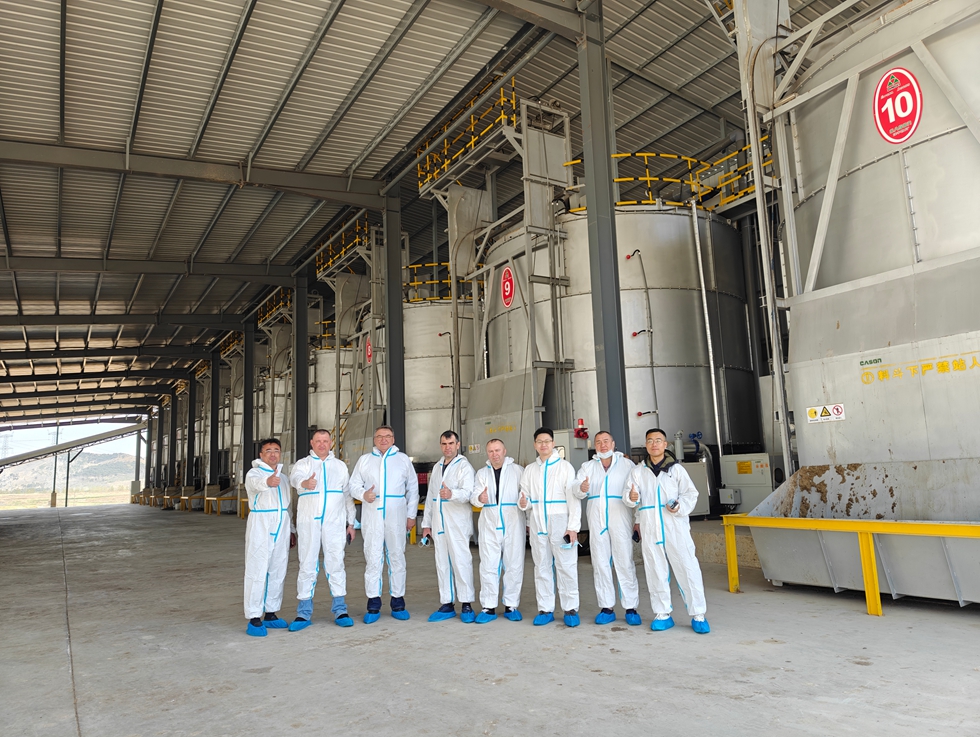
Liuge: the group’s largest single site (10 × C120E)
Liuge operates ten C120E tanks, the largest installation among the five sites, at an estimated 60 tonnes per day. Once scale reaches this point, the difficulty is no longer the vessels themselves but scheduling ten units in parallel: how feed batches are sequenced, how fermentation phases are staggered, and how discharge keeps running without stopping the line. A centralized control approach is what resolves this.
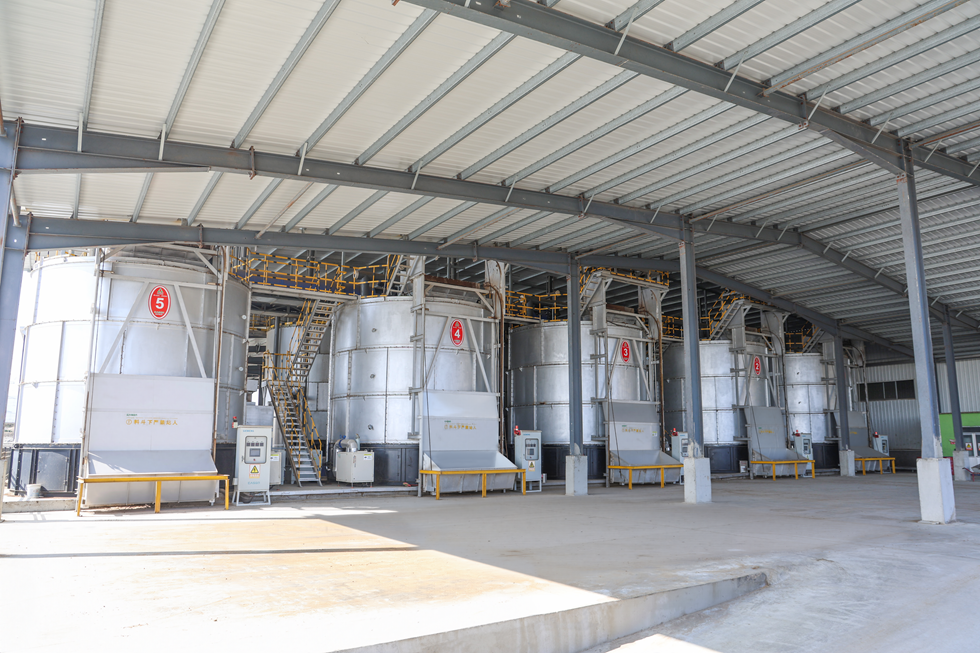
Haodi: the demonstration site (5 × C120E)
Haodi runs five C120E tanks with a demonstration role. A demonstration site differs from a production site in three ways: it receives visitors, it produces operating data that can be published externally, and it proves the economics of the same system at mid scale.
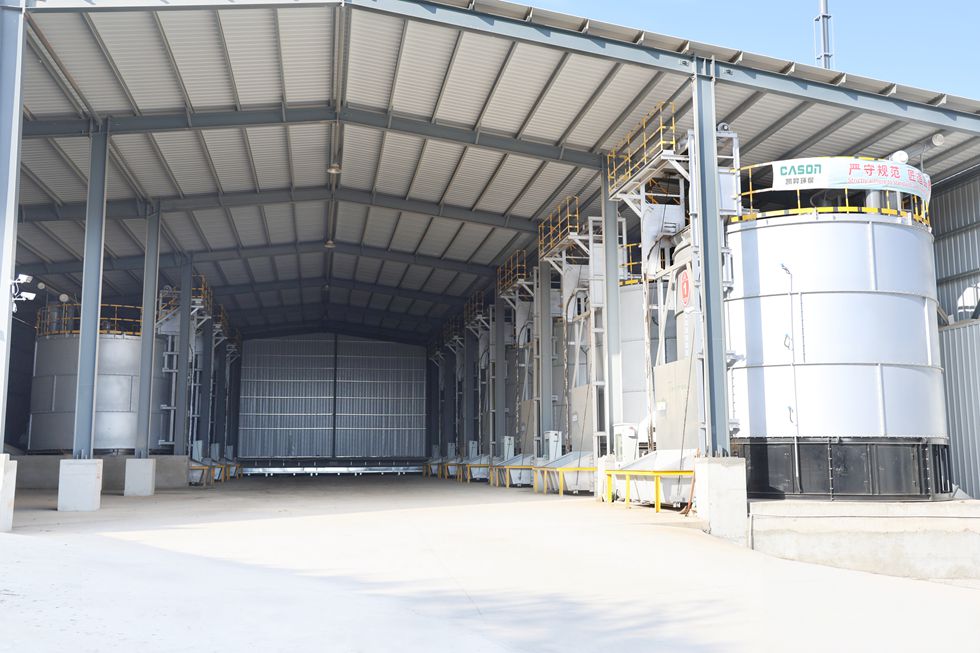
Xiaoji Farm No.1: the only site with a full screening and bagging line (9 × C120E)
Xiaoji No.1 runs nine C120E units plus a complete screening and bagging line, which makes it the first of the five to ship a finished, bagged product. After fermentation, the cured material passes through screening for grading and impurity removal, then goes to the bagging unit for automatic packing — all within one continuous line. The difference looks like two extra steps, but what changes is the sales format: without screening and bagging the site sells loose composted material; with it, the product can enter retail and distribution channels as bagged organic fertilizer.
Xiaoji Farm No.2: repeating a configuration already proven (5 × C120E)
Xiaoji No.2 uses five C120E tanks supported by a full set of screening and bagging equipment, largely repeating the Xiaoji No.1 combination. Running the same downstream configuration at two farms in one area means shared spares, shared quality control standards and a shared sales channel, which brings marginal cost down noticeably.
From chicken house to organic fertilizer
Laid out end to end, every stage has a clear input and output:
- Houses: belt-based cleaning removes manure promptly and consistently from the rearing space
- Central collection: prevents manure from accumulating across the breeding area and prepares it for uniform treatment
- Enclosed tanks: high-temperature aerobic fermentation for sanitation and curing
- Screening: uniform particle size and impurity removal to meet commercial product appearance
- Automatic bagging: a finished product that can be transported and sold
One point is worth stating plainly: an organic fertilizer fermentation tank should not be treated as a standalone machine. In practice it does two jobs. It gets manure out of the houses promptly and in a controlled way, improving conditions inside the house; and it concentrates manure into a single contained unit where hygienic fermentation is straightforward, rather than leaving it scattered around the site. Buying tanks while ignoring collection upstream and finishing downstream still leaves the chain incomplete.
Frequently asked questions
How many C120E tanks does a large layer farm need?
It depends on daily manure output and how much buffer the operator wants. Calculate daily output from flock size, divide by roughly 6 tonnes of stable feedstock throughput per tank per day, then add 10–15% so units can be serviced without stopping production. If bulking agents are blended in to adjust moisture, total throughput rises and the tank count needs to move up accordingly.
How does high-temperature aerobic fermentation differ from open windrow composting?
Three differences stand out. Containment: the reaction happens inside a sealed vessel with odor captured and treated, whereas windrows emit uncontrolled. Control: temperature, oxygen supply and mixing are adjustable per fermentation stage instead of depending on weather. Cycle time: enclosed high-temperature conditions cure material considerably faster than windrows and need far less land. The trade-off is capital cost and power consumption.
Can fermented chicken manure be sold directly as organic fertilizer?
Freshly discharged material is usually classified as composted feedstock, not yet a saleable commercial fertilizer. To reach that point it generally needs screening, grading and impurity removal, plus testing against the relevant standard for organic matter, nutrients and moisture. At Dingli, Xiaoji No.1 and No.2 can ship a finished product because they run screening and bagging lines; the other sites focus on the sanitation step.
Why should a multi-site operator choose centralized treatment?
The main gains are avoiding duplicated investment and running one consistent environmental management system. Routing manure from several sites to a shared treatment center lets the group reuse spares, control systems, deodorization units and maintenance staff, keeps environmental records in a single system, and makes responsibility clear when something goes wrong. Standardizing on one tank model across all five Dingli sites serves the same purpose for spares and service know-how.
Does the system need separate deodorization equipment?
Yes. The tanks solve containment: they turn diffuse odor into a captured, ducted exhaust. That exhaust still has to pass through centralized deodorization before discharge. CASON typically pairs centralized deodorization with multi-tank group control to close the environmental loop.
Final thoughts
What makes Dingli worth studying is not that it bought 35 tanks. It is the sizing method: break down the site conditions first, then decide tank count and downstream equipment, then tie all five sites together into one manageable system using a common model and a common process route. For any producer planning to scale up, working out flock sizes and cleaning methods before discussing equipment capacity usually saves a good deal of rework.